
AUTOMATE PLANET · WEBSITE MEASUREMENT
Why a checkout click is not a sale: our conversion test
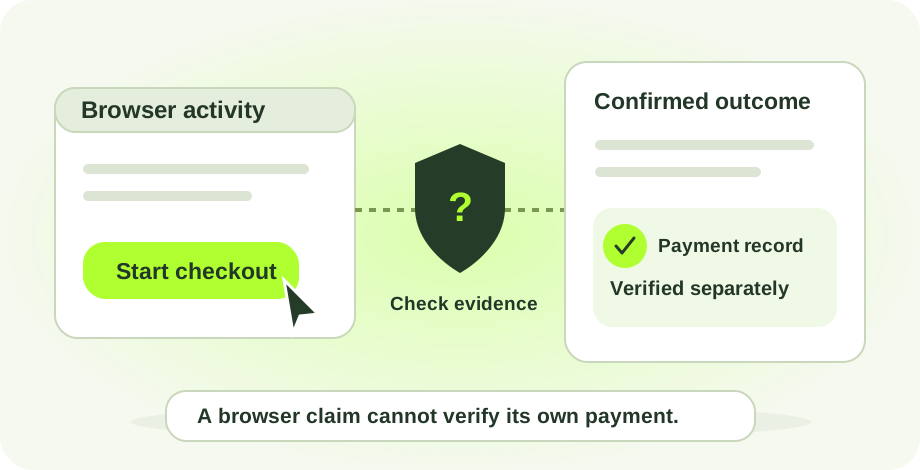
A checkout click records an attempt to buy, not a completed payment. Keep package views, checkout starts and payment-provider handoffs separate from verified outcomes. Confirm a payment against an authoritative transaction record and connect it to a visitor only when a reliable reference exists. If that confirmation is unavailable, report the outcome as unknown rather than counting a click as a sale.
Three steps. Different evidence.
- 1Checkout startsObserved website activity
- 2Evidence checkedAuthenticate and match the record
- 3Payment confirmedCount a completed transaction
A useful sales report needs more than button counts
When we built Automate Planet’s website measurement, we separated what a browser observes from what a business can confirm. A visitor can open a package, start checkout and leave for the payment provider without completing a purchase. The implementation lesson is to preserve those useful steps without giving them a stronger label than their evidence supports.
That distinction helps an owner ask a better question. If many visitors start checkout but the payment outcome is unknown, the report does not yet establish abandonment or successful sales. First connect the outcome evidence; then investigate the journey. Otherwise a tracking gap can look like either business growth or a sales problem.
Our broader guide to measuring business results covers choosing meaningful outcomes. This page focuses on a narrower acceptance question: can browser-supplied activity promote itself into a confirmed purchase?
What our four local checks actually showed
On October 27, 2026, we ran the existing focused conversion-measurement test suite against a local copy of our website’s measurement logic. All four tests passed. The suite used invented event identifiers and contact details; it did not connect to payment services, send a message or create a live appointment.
| Check | Input or method | Observed result |
|---|---|---|
| Traffic-source limits | Supply a landing URL with campaign fields, an email field and a private search term; supply a referrer with a query. | Expected campaign fields and referrer hostname retained; query detail and email field not retained. An email-like campaign value was excluded. |
| Attribution age and privacy signals | Check a fabricated record at 29 days, 30 days and before its creation; check configured privacy-signal inputs. | 29-day record accepted; 30-day and future-dated records rejected. The tested privacy signals disabled optional measurement eligibility. |
| Invented payment and booking outcomes | Try four disallowed outcome event types, including payment and appointment claims, with a supplied verification label. | All four were refused by the browser allowlist and local event validator. A permitted checkout-start event kept the browser-observed label and omitted supplied email and transcript fields. |
| Consent and event references | Submit events without affirmative consent, with a malformed identifier, and with an inquiry missing a reference; then use a well-formed reference. | The first three inputs were rejected. The inquiry input with a valid-format reference passed local validation. That does not prove the referenced inquiry exists. |
The count is four test cases, not four customers or four purchases. Some tests contain several assertions. A passing assertion only establishes the selected behavior for the supplied inputs; it does not establish comprehensive privacy protection or resistance to every attack.
How to repeat the trust check without making a purchase
- Choose one permitted activity. We used a checkout-start event as the baseline. Give it fabricated identifiers and affirmative measurement consent so unrelated validation failures do not hide the boundary being tested.
- Change only the claimed outcome. Replace the activity type with a purchase, verified-payment or confirmed-appointment claim. Add a field claiming that the provider verified it. Both the client-side allowlist and the receiving validator should reject the claim.
- Return to the permitted activity. Submit the original checkout-start type with that same claimed verification field. Inspect the normalized output: it should remain browser-observed, not provider-verified.
- Add data the measurement record does not need. Our fabricated email and transcript fields were omitted from the returned analytics object. This is a field-level check, not proof that every layer of a live system has removed the data.
- Keep consent and reference tests separate. Test refusal without affirmative consent and require an appropriate reference for an inquiry. A format-valid reference still needs an existence check in the actual application.
- Retain the exact test output and code revision. Keep the date and scope with the result. Re-run after changing the validator or checkout journey rather than reusing an old pass as current evidence.
Our local suite called the measurement helpers and event validator directly. It did not exercise a deployed endpoint, storage permissions, a real browser session or a provider webhook. Those are separate acceptance tasks. We retained the command output privately; no customer records were used in this article.
A worksheet for deciding what each event proves
Keep uncertainty visible.
This is an original acceptance worksheet based on our implementation. It describes evidence to request from a website team; it is not a claim that every row is connected or verified on our current site.
| Stage | What you can count | What is still needed |
|---|---|---|
| Package viewed | A measured package view under the site’s measurement rules. | Do not infer purchase intent, an identified person or a sale. |
| Checkout started | An observed entry into the checkout journey. | A separate payment record before counting a completed purchase. |
| Sent to payment provider | A recorded handoff or outbound click. | The final transaction status; opening the provider is not proof of paying. |
| Inquiry accepted | An inquiry stored successfully and matched to its reference. | A decision about what qualifies as a lead and how duplicates are handled. A button click alone is insufficient. |
| Appointment confirmed | An authoritative, non-canceled booking record. | A tested connection to the booking source; opening a calendar is not confirmation. |
| Payment confirmed | An authenticated completed transaction linked to the right business and order. | Separate handling for repeat billing, refunds, reversals and unavailable visitor attribution. |
Add four fields when using this worksheet: the source of truth, the responsible owner, the last tested date and the unresolved gap. A blank confirmation field should stay visible as “not connected” or “not verified.” Do not turn unavailable data into a zero or fill the gap by guessing from nearby timestamps.
What confirmation adds after the click
PayPal describes webhooks as server notifications and distinguishes receipt from verification. It also explains that notifications are associated with the app processing the event. Receiving a message alone is therefore insufficient evidence that it came from the payment provider or belongs to the intended integration.
PayPal’s subscription event list separates subscription creation and activation from a completed payment, refund, reversal and payment failure. A reporting design should preserve those differences rather than count every subscription event as a new sale.
Our proposed acceptance rule is to authenticate the provider evidence, check the transaction’s status and relationship to the expected order, and record each transaction once. Keep subsequent recurring payments separate from acquisition of a new client. If a payment cannot be reliably linked to an original measured visit, retain the payment record and mark its traffic source unknown.
Our retained October 20 integration notes recorded gaps in automatic payment and appointment verification. Today’s local test did not inspect or certify current provider configuration and does not close those gaps. It demonstrates a refusal boundary: browser activity cannot supply its own outcome verification through the tested validator.
Ask for a journey you can understand and measure
Before approving a connected website, ask the team to show the activity labels, the independent outcome source and a failed or missing-confirmation example. Request a plain-language explanation of what the report cannot yet tell you. That is more useful than a dashboard that makes every click look like revenue.
Optional measurement choices also affect what is available. Our cookie and measurement page explains the website’s visitor controls. The local tests above check specific consent and privacy-signal behavior; they are not a legal compliance audit or a claim that all visitors can be tracked.
For a website project, include the evidence worksheet alongside design, content and checkout requirements. Explore business websites or connected website services, then choose your industry’s package. Agree which steps will be measured at launch and which outcome connections need separate implementation and verification.
Common questions
Does clicking Buy now count as a purchase?
No. It is an action in the buying journey. Count a completed payment only when an authoritative transaction record establishes it. A payment-provider handoff and a return to the website are not sufficient by themselves.
What did Automate Planet test on October 27, 2026?
We ran four focused local tests covering traffic-source filtering, attribution age and privacy signals, rejection of invented purchase or appointment claims, and consent/reference validation. All four passed. The suite used fabricated inputs and did not make live purchases or send messages.
Do these tests prove that live payments are tracked correctly?
No. They exercise selected local helpers and validation paths. Provider configuration, webhook authentication, transaction matching, storage and reporting require separate tests. A local refusal test is not an end-to-end payment verification.
Can a valid inquiry reference prove that a lead exists?
No. A correctly formatted reference only passes a format check. The application still needs to confirm that the corresponding inquiry was actually stored and that it can be matched safely.
How should unknown payment attribution appear in a report?
Keep the confirmed transaction and label the traffic source unknown when no reliable link exists. Do not guess a source from timing or popularity, and do not treat missing verification as evidence of zero sales.
Is this a security or privacy certification?
No. This is a dated, narrow implementation test and a proposed reporting worksheet. It does not establish comprehensive security, privacy or legal compliance.
Sources and editorial approach
- PayPal Developer: Webhooks overview
- PayPal Developer: Subscription webhook events
- Automate Planet: Website measurement and cookie choices
How this page was prepared. AI-assisted writing based on documented Automate Planet work and the sources linked here. This is our implementation account, not an independent evaluation.
Observed October 27, 2026: four local automated tests passed using fabricated inputs. No network requests, purchases, appointments or messages were made by this focused test suite. These results validate selected code paths, not a live payment integration, a security certification, a conversion rate or a revenue result.
Make the next step work for your business.
Compare the scope and deliverables. Our AI can help you choose a package before you buy.
Find my packageExplore all resourcesYour next chapter.
Starts here.
Tell us what you want to make easier. We’ll help connect the right people, processes, and AI.
Make time for what’s next.
A one-hour consultation to explore your goals, workflows, and opportunities.